Though He existed in the form of God, He did not regard equality with God a thing to be grasped, but emptied Himself, by taking the form of a servant, being made in the likeness of men. And Being found in appearance as a man, He humbled Himself by becoming obedient to the point of death, even death on a cross. (Philippians 2:6-8)
Many of us wrestle with how God can be good in a world full of evil. Relevantly, this hard question is dramatically explored in the movie, Batman vs. Superman.
In the movie, every act of heroism displayed by Superman is coupled with severe collateral damage. As a result, humanity is unsure of whether to praise Superman as an all-powerful savior or condemn him as a dangerous alien.
The film’s villain, Lex Luthor, captures the essence of this dilemma well in his dialogue with Superman. He shouts at Superman: “If God is all-powerful he cannot be all-good, and if he is all-good he cannot be all-powerful . . . and neither can you be.”
To paraphrase Luthor’s philosophical conundrum: If God allows evil to continue because he can’t stop it; then he might be good but he’s not all-powerful. Conversely, if God allows evil to continue when he can stop it and yet chooses not to; then he may be all-powerful but he is certainly not good. Either way, an all-powerful and all-good God cannot exist.
At first blush, Lex Luthor appears to have delivered a fatal blow to the argument for God—as well as create doubt in Superman’s goodness and power. However, before we proclaim the evil genius as the victor, we should be mindful of the wisdom of C.S. Lewis (a real life genius). Lewis taught his readers the critical importance of examining the assumptions within a question. Interestingly, in applying Lewis’ instruction to our hard question (“How God can be good in a world full of evil?”), a very significant assumption is found.
To say there is evil is to assume there is such a thing as good. When Lex announces there is such a thing as “good” he is assuming there is a moral law on the basis from which to differentiate between good and evil. As C.S. Lewis reasoned: some kind of “standard of behavior” which we expect our fellow man to know about (an objective moral standard). Without such an objective moral standard, we simply have value judgments between separate societies, cultures, and persons (e.g. Lex Luthor’s notion of what is good versus Superman’s).
Importantly, if there is an objective moral law there must be an objective moral law giver (i.e. God). Otherwise, where would such an objective moral standard come from? If no objective moral law giver exists, then we have no objective moral standard to live our lives by.
Following this logic further, if there is no objective moral standard then there truly is no such thing as good. And if there is no good . . . then there can be no evil.
Yet, we know this is not true. We know Superman is our hero! We know slavery, rape, and other forms of oppression must be condemned. That’s why we cringe at unjust historical events. That’s why we denounce racism and bigotry. That’s why we abhor senseless violence and cry out for the dignity of all persons. We inherently know right from wrong. We know good from evil. Thus, our hard question (“How God can be good in a world full of evil?”) does not dislodge God but actually provides a powerful argument for His existence.
Ironically, Lex Luthor must therefore rely on God to make an argument against Him. To quote Dostoyevsky: “if God does not exist everything is permitted.” So, the presence of evil actually becomes a bigger problem for disbelief in God. If there is no God, on what basis do we even ask our hard question?
However, our hard question still grieves us. For that reason, philosophical and intellectual arguments will not suffice to completely disarm what the presence of evil does to our hearts. Deep within we know something is wrong with the state of our world and it makes the reality of God and His goodness difficult to believe.
But before we attempt to reconcile this conflict further, let’s get back to the movie. How does Superman seek to resolve the doubt humanity has in his goodness?
WARNING: Major Batman v. Superman spoiler ahead:
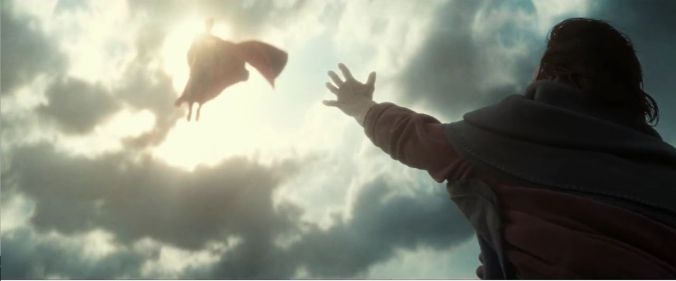
In the midst of his rejection by humanity, Superman willingly lays down his life to destroy Doomsday (an evil creature created by Lex Luthor) and save the world from utter ruin. As the world mourns Superman’s death, his sacrifice forever proves his love for mankind and his commitment to the flourishing of humanity.
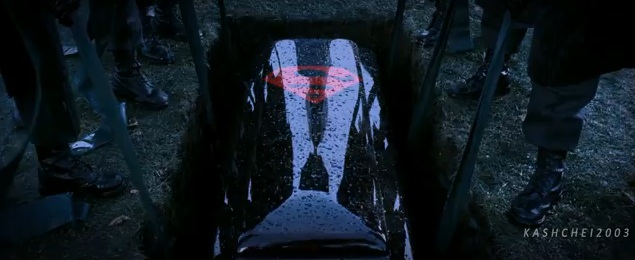
So, how does God answer our hard question?
He entered into infinite suffering himself.
The son of God took on human flesh in the person of Jesus. He lost his heavenly home and became a wanderer on earth, deprived of all his glory, homeless and hungry, disgraced and ridiculed, abandoned by his friends, and sentenced to death unjustly at the hands of a corrupt tribunal. Ultimately, Jesus experienced suffering to a degree no other human has: He was cast away from God’s presence (the source of all love, light, and life) and thrust into complete spiritual darkness – Cosmic and Infinite suffering.
No other religion even begins to offer such a response to the problem of pain and suffering.
As Tim Keller persuasively argues:
The God of the gospel is the only god that doesn’t just write us a book on the problem of pain and send it down and say here is what that means. He is the only god that actually comes down and shares in the forsakenness that we feel in a universe gone wrong.
But why did he do it?
He did it for us. Jesus underwent cosmic and infinite suffering out of cosmic and infinite love for us—His passion.
He was shut out so we could get access. He was bound, nailed, so that we could be free. He was cast out so we could approach. And Jesus took away the only kind of suffering that can really destroy you: that is being cast away from God. Tim Keller, Walking with God through Pain and Suffering
And He did it at infinite cost to himself.
His sacrifice for us proves his friendship (watch Jesus’s Death as an act of friendship). At the foot of the cross we can say to God, “now we know that you love me, because you laid down your life for me.” (John 15:13)
That is the Gospel.
* * * * *
The Gospel gives us the ultimate Superman who comes down to bear the evil and injustice of this world and die for it so that some day he can end evil without having to end us.
To the degree we rest in that truth, our hard question begins to soften. My hope and prayer for all of us is that we will take our pain and our suffering and place it at the foot of the cross. For it is there where we will find the assurance of His love for us and His promise to one day end all evil—the day when all things are made new.
* * * * *
FOR A SEARCHING SOUL
Martin Luther King, Jr., in his Letter from a Birmingham Jail, reasoned that the only way to know a law is unjust is if there is a divine, higher law that tells us so. He argued that if there was no higher natural law, then how could anyone know if a human law was morally wrong?
Perhaps no one has argued this point better than former atheist C.S. Lewis:
My argument against God was that the universe seemed so cruel and unjust. But how had I gotten this idea of just and unjust? A man does not call a line crooked unless he has some idea of a straight line. What was I comparing this universe with when I called it unjust . . . . A man feels wet when he falls into water, because man is not a water animal: a fish would not feel wet . . . . Thus in the very act of trying to prove that God did not exist . . . I found I was forced to assume that one part of reality—namely my idea of justice—was full of sense. Consequently, atheism turns out to be too simple. If the whole universe has no meaning, we should never have found out that it has no meaning: just as, if there were no light in the universe and therefore no creatures with eyes, we should never know it was dark. Dark would be a word without meaning.
To summarize MLK and Lewis: If there is no outside criteria for truth, justice, fairness and the like (morality), no criteria outside of me, then I can never rationally urge others to behave the way I think they ought to. It’s merely my personal preference instead of someone else’s. That is to say: if there is no higher, natural law (i.e. God), one may say that a law is unjust, but that would be according to their own standards or their own feelings.

My favorite adaptation of Batman v. Superman (Johny and Joey Lemieux)
For additional resources on this topic, see:
- Tim Keller: Walking With God Through Pain and Suffering
- Tim Keller Sermons: Suffering:if God is good why is there so much evil in the world; The Final Hour
- C.S. Lewis: Mere Christianity; The Problem of Pain













 asearchingsoul.com